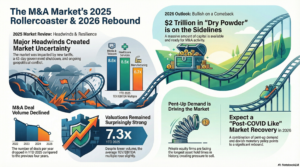
If 2025 felt like a confusing year for mergers and acquisitions, you’re not alone. The market sent mixed signals: deal volume slowed, uncertainty rose, yet valuations remained surprisingly resilient. For business owners considering a sale—and buyers waiting on the sidelines—understanding what actually happened in 2025 is key to positioning correctly for what’s coming next.
Here’s a clear breakdown of the M&A “rollercoaster” and why many professionals are increasingly bullish on 2026.
2025 Market Review: Headwinds, Not a Collapse
The M&A market in 2025 faced real challenges. New tariffs, a prolonged government shutdown, and ongoing geopolitical conflict created uncertainty that caused many buyers and sellers to pause.
As a result:
-
Deal volume declined compared to prior years
-
Buyers became more selective
-
Sellers delayed exits waiting for clarity
However, this was not a systemic breakdown—it was a hesitation cycle.
Deal Volume Fell, but Valuations Held Up
One of the most important takeaways from 2025 is that lower deal volume did not translate into weaker pricing.
-
Average YTD 2025 TEV/EBITDA multiple: ~7.3×
-
Despite fewer transactions, multiples actually rose slightly
This tells us something critical: quality businesses are still commanding strong valuations. Capital didn’t disappear—it waited.
Sector Multiples Tell the Story
Certain industries continued to attract premium valuations even during uncertainty:
-
Media & Telecom: ~8.6× EBITDA
-
Healthcare Services: ~8.5× EBITDA
-
Manufacturing: ~6.7× EBITDA
Buyers remained active where revenue visibility, recurring demand, and operational scalability were present. This pattern mirrors what we see consistently in the lower-middle market as well.
The Dry Powder Problem (and Opportunity)
Looking ahead, one statistic stands out:
Over $2 trillion in private equity “dry powder” is sitting on the sidelines.
That capital has to be deployed.
Private equity firms are now facing the longest average asset hold times in history, which creates pressure to transact—both selling existing portfolio companies and acquiring new platforms.
This pent-up demand didn’t vanish in 2025. It accumulated.
Why 2026 Looks Like a Release Valve
Many analysts are pointing to 2026 as a potential “post-COVID-like” recovery year for M&A activity.
Key drivers include:
-
Pent-up buyer and seller demand
-
Capital that must be deployed
-
Stabilizing interest rate expectations
-
Increased confidence once uncertainty clears
When confidence returns, deal flow tends to rebound quickly.
What This Means for Business Owners
For owners considering a sale in the next 12–36 months, timing and preparation matter more than ever.
-
Strong businesses are still selling at solid multiples
-
Buyers are rewarding clean financials and scalable operations
-
Well-prepared sellers will benefit most when volume accelerates
Waiting for the “perfect” market often means missing the best window. Preparation—not prediction—is what creates leverage.
Final Thoughts
The M&A market didn’t fall apart in 2025—it paused. Valuations stayed firm, capital piled up, and pressure is building for renewed activity. As we move toward 2026, those who are informed and prepared will be best positioned to take advantage of the rebound.
If you’re thinking about selling, acquiring, or simply want to understand where your business fits in this evolving market, a confidential conversation can provide clarity.
Michael Shea
Business Broker | Transworld Business Advisors of Tampa
👉 www.yourfloridabusinessbroker.com
Michael Shea represents the Tampa Florida Transworld office. In business since 2005, he has established a reputation as a trusted business broker across Florida’s key markets- from Tampa to Orlando, Melbourne, and more. Over the past two decades, Michael and his team have closed over $1 Billion in sold business volume and presided over more than 450 transactions. His credentials include the IBBA Certified Business Intermediary®, and most recently, the prestigious Certified Exit Planning Advisor® (CEPA) credential.