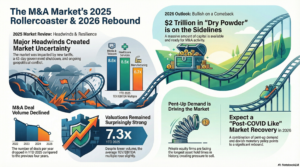
After a year of navigating what many experts call an “economic rollercoaster,” the M&A landscape is preparing for a significant acceleration in 2026. While 2025 was marked by high-stakes megadeals and aggressive tariff-related shifts, the coming year signals a “back-to-basics” recovery driven by narrowing valuation gaps and a massive stockpile of undeployed capital.
Here is what business owners and investors need to know about the transition from 2025 to the 2026 rebound.
The 2025 Rollercoaster: Strategic Adaptability
The 2025 market proved to be a year of disparate dynamics. While the number of deals fell roughly 12%, total transaction volume rose by 30%, fueled by a record wave of “mega-deals” exceeding $10 billion.
-
Strategic Scale: High interest rates and cost pressures favored scale deals, especially in high-fixed-cost industries like financial services and energy.
-
The Tariff Fog: Persistent tariff-related headwinds made forecasting challenging, forcing many businesses to rethink supply chains and delaying some middle-market closings.
-
AI as a Lever: Approximately 77% of market players now view Artificial Intelligence as a primary lever for value creation and a key driver of future activity.
2026 Predictions: Momentum and Pressure
The outlook for 2026 is distinctly bullish, with North American buyers expected to lead a dramatic turnaround after ten consecutive negative quarters.
1. Narrowing Valuation Gaps
A persistent obstacle in 2025 was the disconnect between what sellers wanted and what buyers were willing to pay. In 2026, valuation gaps are expected to narrow further as financing conditions stabilize, finally unlocking the pipeline for “sponsor-to-sponsor” deals.
2. The $2 Trillion “Dry Powder” Catalyst
Private equity firms are approaching a tipping point. With over $2 trillion in undeployed capital (dry powder) and intensifying pressure to return capital to investors, PE firms will increasingly hunt for quality assets.
3. “Buy-and-Build” vs. Transformative Deals
Instead of risky, one-off transformative moves, 2026 will see a strategic shift toward de-conglomeration. Companies will focus on core strengths, making smaller, complementary acquisitions to achieve rapid expansion and integrate critical technologies.
Sector Hotspots for 2026
While the broader market gains momentum, certain sectors are poised for outsized growth:
| Sector | Outlook Trend |
| Technology/AI | Hyperscalers and software-related deals lead the way. |
| Energy/Infrastructure | Transition to electrification and energy transition markets. |
| Healthcare/Biopharma | Stable cash flows and fragmented landscapes remain highly attractive. |
| Industrial Manufacturing | Consolidation across automation and energy sectors. |
Preparing for the Rebound
As market conditions stabilize, successful buyers and sellers should begin preparation at least 36 months in advance.
-
Clean Financials: Prepare 36 months of normalized monthly financials and commission a Quality of Earnings (QoE) report early.
-
Tech Diligence: Expand diligence beyond financials to include technology, cybersecurity, and AI utilization, as PE firms will increasingly pay premiums for companies that take cyber-resilience seriously.
-
Cultural Integration: Early integration planning during the due diligence phase will be vital for buyers looking to lock in gains amidst ongoing geopolitical complexities.
The “tariff fog” is clearing, interest rates are finding a supportive policy shift, and the market is primed for a fundamentals-driven recovery. 2026 is shaping up to be the year that “disciplined, well-timed M&A” strengthens long-term positions.
Would you like me to analyze a specific industry’s EBITDA multiples for your next acquisition?
Michael Shea represents the Tampa Florida Transworld office. In business since 2005, he has established a reputation as a trusted business broker across Florida’s key markets- from Tampa to Orlando, Melbourne, and more. Over the past two decades, Michael and his team have closed over $1 Billion in sold business volume and presided over more than 450 transactions. His credentials include the IBBA Certified Business Intermediary®, and most recently, the prestigious Certified Exit Planning Advisor® (CEPA) credential.