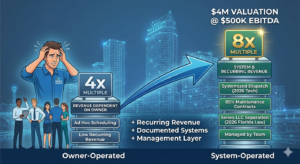
If you own an HVAC company, a plumbing outfit, or an electrical contracting business in the Tampa Bay area, you’re sitting on something that buyers want. The Gulf Coast trades market is one of the more active segments I work in, and the demand for established, well-run service businesses in this region is real and consistent. But there’s a wide range in what trades businesses actually sell for — and understanding what drives that range is what separates a 2.5x seller from a 4x seller.
Let me break down what I’ve seen in actual transactions across the Gulf Coast trades market over the past several years.
What “The Multiple” Actually Means
When brokers talk about a multiple, they’re typically referring to a multiple of Seller’s Discretionary Earnings — what the industry calls SDE. SDE is essentially the total economic benefit to the owner: net profit, plus owner’s compensation, plus any non-cash or non-recurring expenses that can be added back. It’s the true cash flow the business generates for the person who owns and operates it.
A business selling for a 3x multiple of SDE means a buyer is paying three years’ worth of that owner benefit upfront. For a trades business generating $400,000 in SDE, that’s a $1.2 million valuation. Increase those add-backs legitimately, improve the story around recurring revenue, and tighten up operations — now you’re having a 4x conversation, which puts you at $1.6 million. That’s a $400,000 difference, and it’s achievable.
The Five Levers That Move a Trades Multiple
- Recurring Revenue
Nothing moves a trades multiple faster than documented recurring revenue. Service agreements, maintenance contracts, preventive maintenance programs — whatever you call them — these are gold to a buyer. They represent predictable future cash flow that reduces risk. An HVAC company with 200 active maintenance agreements is a fundamentally different business than one doing the same revenue on pure break-fix calls. If you don’t have a service agreement program, building one 12–18 months before you sell is one of the highest-return activities you can do.
- Owner Independence
Buyers pay a premium for a business that doesn’t collapse when the owner steps back. If your customers call your cell phone directly, if you’re the one doing the estimates, if your technicians can’t make decisions without you — a buyer sees that as a liability. They’re asking themselves: will this business still work when I’m the owner? Build out a service manager, document your estimating process, and make sure your customer relationships are tied to the company, not to you personally.
- Technician Stability
In the current labor environment, a stable, licensed, and tenured field team is worth real money. High technician turnover is one of the first things buyers raise in due diligence, because replacing licensed tradespeople in the Tampa Bay market is expensive and slow. If you’ve built a team that shows up, gets the work done, and stays — document it. Years of service, certifications, any benefits you provide. That team is part of the asset you’re selling.
- Revenue Concentration
This goes both ways. If 40% of your revenue comes from one general contractor or one property management company, that’s a concentration risk that a buyer will price into a lower offer — or a larger holdback. Diversifying your revenue base before going to market reduces that negotiating leverage on their side. Conversely, having strong residential AND commercial revenue is often viewed positively, because it signals a business that can weather cycles.
- Clean and Consistent Financials
We’re back to the financials conversation because in the trades, it’s particularly important. A lot of small contractors have years where revenue looks lumpy — a big commercial job one year, slower the next. Buyers want to see three years of data and understand the story behind the variation. If you can show consistent SDE growth, even modest growth, that tells a buyer the business has momentum. That story is worth multiples.
The Tampa Bay Advantage
Here’s something I tell out-of-market buyers all the time: the Gulf Coast trades market is one of the most structurally sound in the country for a business acquisition. Population growth in Hillsborough, Pinellas, Pasco, and Manatee counties continues to be among the highest in the Southeast. New construction drives installation work. Florida’s aging housing stock drives service and replacement. The regulatory environment requires licensed contractors, which creates a natural barrier to entry. If you own a licensed, established trades business in this market, you own something genuinely hard to replicate.
Where to Start
If you’re 5 years from retirement or 2 years from retirement, the conversation is different — but it’s always worth starting. I can give you a confidential, no-obligation opinion of value for your trades business, and we can map out what it would take to move from where you are today to where you want to be at closing. Most owners are further along than they think. Some have a year or two of work ahead of them. Either way, knowing is better than guessing.
Michael Shea represents the Tampa Florida Transworld office. In business since 2005, he has established a reputation as a trusted business broker across Florida’s key markets- from Tampa to Orlando, Melbourne, and more. Over the past two decades, Michael and his team have closed over $1 Billion in sold business volume and presided over more than 450 transactions. His credentials include the IBBA Certified Business Intermediary®, and most recently, the prestigious Certified Exit Planning Advisor® (CEPA) credential.