
Most business owners think selling is about timing the market or finding the right buyer.
Buyers see it differently.
They’re not just buying your cash flow—they’re underwriting risk. The less risk they perceive, the more confident they feel, the more leverage you have, and the higher the price you’re likely to receive.
That process is called de-risking, and it’s one of the most misunderstood—and undervalued—parts of preparing a business for sale.
What Does “De-Risking” Mean in a Business Sale?
De-risking is the process of reducing the buyer’s perceived uncertainty about the future performance of your business.
Every buyer asks the same core question:
“What could go wrong after I take over?”
If too many things can go wrong, buyers either:
-
Lower their offer
-
Demand seller financing or earnouts
-
Prolong due diligence
-
Or walk away altogether
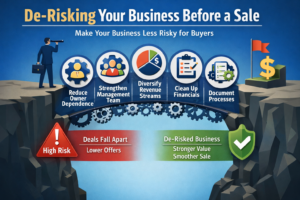
A de-risked business doesn’t eliminate problems—it proves those problems are manageable without the owner.
Why De-Risking Directly Impacts Your Sale Price
Buyers don’t discount businesses because they’re imperfect.
They discount businesses because outcomes are unpredictable.
A risky business might still sell—but usually with:
-
Lower multiples
-
Heavier contingencies
-
More money tied up in performance-based earnouts
-
Greater post-closing obligations for the seller
In contrast, a de-risked business:
-
Attracts more qualified buyers
-
Commands stronger valuation multiples
-
Closes faster with fewer renegotiations
-
Gives the seller cleaner exits
In many cases, de-risking adds more value than growing revenue in the final 12–24 months before a sale.
The Most Common Risk Factors Buyers See
While every industry is different, buyers consistently focus on a few core risk categories:
Owner Dependence
If the business relies heavily on you for sales, relationships, operations, or decision-making, buyers worry it will decline once you’re gone.
Customer Concentration
When one or two customers represent a large percentage of revenue, buyers fear losing them post-close.
Key Employee Risk
If critical employees could leave without notice—or aren’t contractually secured—buyers see operational fragility.
Lack of Systems and Documentation
Tribal knowledge lives in people’s heads, not processes. That’s a red flag.
Inconsistent Financials
Messy books, aggressive add-backs, or unclear margins create trust issues during due diligence.
How to De-Risk Your Business Before Selling
De-risking doesn’t happen overnight. It’s a series of intentional improvements that make your business easier to transfer.
Here’s where owners should focus first:
1. Reduce Owner Dependency
Start stepping out of day-to-day operations well before selling.
-
Delegate decision-making authority
-
Shift customer relationships to team members
-
Create documented workflows for key tasks
If you can take a two-week vacation without fires, buyers notice.
2. Strengthen Management and Key Employees
Buyers want to know the business will run on Day One.
-
Identify who truly runs operations
-
Put retention agreements or incentives in place
-
Cross-train critical roles
A strong second layer of management reduces transition risk dramatically.
3. Diversify Revenue Sources
You don’t need perfect diversification—but progress matters.
-
Expand customer base where possible
-
Avoid single-client dependency over 20–25%
-
Show a pipeline that supports future growth
Even modest diversification can improve buyer confidence.
4. Clean and Normalize Financials
Financial clarity is non-negotiable.
-
Separate personal expenses from the business
-
Normalize owner compensation
-
Ensure revenue and expenses are consistent and defensible
Clean financials reduce friction, shorten diligence, and protect valuation.
5. Document Systems and Processes
Buyers pay for repeatability.
-
SOPs for operations, sales, accounting, and onboarding
-
Vendor and customer contracts organized and accessible
-
Clear KPIs and reporting cadence
If the business can be “handed off,” it’s inherently less risky.
When Should You Start De-Risking?
Ideally, 2–3 years before selling.
But even six to twelve months of focused de-risking can materially improve deal terms. Waiting until a business is listed is often too late—buyers can see through last-minute fixes.
The strongest exits happen when owners prepare early and sell deliberately.
Final Thought: De-Risking Is About Control
You can’t control the market.
You can’t control buyer behavior.
But you can control how risky—or how transferable—your business appears.
The more predictable your business is without you, the more valuable it becomes.
And when it’s time to sell, that preparation shows up not just in price—but in how smooth the exit actually is.
Michael Shea represents the Tampa Florida Transworld office. In business since 2005, he has established a reputation as a trusted business broker across Florida’s key markets- from Tampa to Orlando, Melbourne, and more. Over the past two decades, Michael and his team have closed over $1 Billion in sold business volume and presided over more than 450 transactions. His credentials include the IBBA Certified Business Intermediary®, and most recently, the prestigious Certified Exit Planning Advisor® (CEPA) credential.