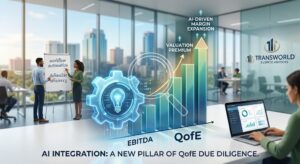
A recent PitchBook analysis highlighted a major shift at the SuperReturn International conference in Berlin: Private Equity firms are facing longer exit timelines and dragged Internal Rates of Return (IRRs) because of the time it takes to properly integrate AI into portfolio companies.
Take Bain Capital’s 2022 acquisition of House of HR, for example. They are actively working to automate formulaic, repeatable tasks like candidate scraping and interview scheduling. As Bain partner Christophe Jacobs van Merlen noted, proving out this structural cost reduction takes time, meaning “right now it’s too early to exit.”
For mid-market business owners and M&A advisors, this signals a massive shift in how companies are evaluated. It means AI integration is no longer a tech-spec issue—it is a Quality of Earnings (QofE) issue.
Redefining the “Quality” in Earnings
Traditionally, a QofE report analyzes a company’s historical financial performance to assess the baseline reliability of its earnings. It strips out anomalies to present a “true” picture of sustainable EBITDA or Seller’s Discretionary Earnings (SDE).
However, as automation reshapes winning business models, savvy buyers are assessing QofE through a forward-looking technological lens:
| Traditional QofE Metrics | Modern AI-Driven QofE Metrics |
| Historical Revenue Sustainability | Defensibility against automated/AI disruptors |
| Working Capital Requirements | Proprietary data assets and embedded workflows |
| Normalized Compensation & Headcount | Structural efficiency of repeatable operational costs |
If a company’s baseline earnings are heavily reliant on human capital performing formulaic, low-leverage tasks, sophisticated buyers see a liability. They see an outdated cost structure that will require significant time, capital, and friction to modernize.
The Two Ways AI Impacts Your Valuation Multiple
From a Q of E standpoint, AI integration cuts both ways during due diligence:
-
The Risk Factor (Replicability): Buyers are looking deep into workflows to see if your margins can be easily eroded. Karen Derr Gilbert of FTV Capital pointed out that institutional investors are heavily vetting whether a business has proprietary data or deeply embedded workflows that can’t be easily replicated by a competitor spinning up an off-the-shelf AI tool. If your product or service is easily replaced by generic automation, your earnings are deemed low-quality.
-
The Scalability Factor (Defensible Margins): When a business has successfully integrated AI to streamline operations, it proves to a buyer that the earnings are highly scalable. It demonstrates that the business can double its volume without doubling its administrative or operational headcount. This directly impacts the valuation multiple a buyer is willing to pay.
The Bottom Line for Sellers
If you are preparing your business for a sale, you cannot afford to treat AI as a buzzword for your pitch deck. Buyers will pull back the curtain during diligence to look at your operational workflows.
To maximize your valuation and ensure a smooth closing, you need to prove that your earnings are backed by modern, defensible efficiencies. The cards are being reshuffled, and the businesses that proactively audit and automate their internal workflows are the ones that will command premium multiples at exit.
Are you looking to evaluate how your current operational workflows might impact a future business valuation, or do you need help structuring content around a specific industry sector?
Michael Shea represents the Tampa Florida Transworld office. In business since 2005, he has established a reputation as a trusted business broker across Florida’s key markets- from Tampa to Orlando, Melbourne, and more. Over the past two decades, Michael and his team have closed over $1 Billion in sold business volume and presided over more than 450 transactions. His credentials include the IBBA Certified Business Intermediary®, and most recently, the prestigious Certified Exit Planning Advisor® (CEPA) credential. He is also a Florida Licensed Real Estate Broker and Business Brokers of Florida Board Certified Intermediary