By Michael Shea, CBI, CMAP – Transworld Business Advisors of Tampa
As business owners approach the critical phase of transitioning their companies, understanding the barriers to value enhancement is essential. Drawing from recent industry data, this post examines why different generations may forego formal pre-transition planning and what that implies for effective business exits.
From my experience as a business broker facilitating transitions across industries in Central Florida, the reluctance to engage in formal pre-transition value enhancement often stems from a mix of perceived urgency, resource constraints, and awareness gaps. Baby Boomers and Generation X owners, typically more established in their careers, view such processes as optional luxuries rather than necessities, prioritizing immediate operations over long-term optimization. In contrast, Millennials, who are earlier in their ownership journeys, show a greater openness influenced by higher education levels but are hindered by uncertainty in initiating the process.
This generational divide highlights a broader challenge in exit planning: value enhancement isn’t just about boosting sale prices—it’s a strategic exercise in de-risking, maximizing potential, and positioning for seamless transfers. Advisors like myself observe that skipping this step can lead to undervalued assets or complicated handovers, yet the data suggests many owners underestimate its impact until the exit looms closer. Interpreting these trends, it’s clear that targeted education could bridge these gaps, encouraging proactive steps without overwhelming busy entrepreneurs.
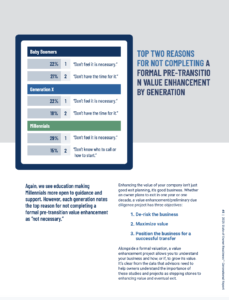
The insights are derived from the 2023 National State of Owner Readiness Report by the Exit Planning Institute, which surveyed business owners on their preparedness for transitions. On page 45, the report breaks down the top reasons for not completing formal pre-transition value enhancement by generation, revealing consistent patterns of perceived irrelevance across cohorts.
For instance:
- Among Baby Boomers, 43% cited lack of necessity or time as primary barriers, aligning with benchmarks from similar studies like the 2013 EPI report, where over 70% of owners lacked formal exit plans.
- Generation X mirrored this at 40%, but with slightly less emphasis on time constraints, suggesting a benchmark of operational inertia in mid-career owners.
- Millennials stood out with 44% pointing to necessity doubts, plus an additional hurdle in knowing how to start, which correlates with EPI’s finding that education increases openness to guidance—Millennials reported higher formal education levels, making them 20-30% more receptive to advisory support compared to older generations.
Real-world examples include manufacturing firms I’ve advised where Boomer owners delayed enhancements, resulting in 15-25% lower valuations due to unaddressed risks, versus Millennial-led tech startups that, once guided, achieved smoother exits through preliminary due diligence. Industry benchmarks from sources like BizBuySell’s quarterly reports reinforce that businesses with pre-transition planning fetch premiums of 10-20% above market averages.
Key Reasons for Not Completing Pre-Transition Value Enhancement
| Generation | Top Reason (Percentage) | Second Reason (Percentage) |
|---|---|---|
| Baby Boomers | Don’t feel it is necessary (22%) | Don’t have the time for it (21%) |
| Generation X | Don’t feel it is necessary (22%) | Don’t have the time for it (18%) |
| Millennials | Don’t feel it is necessary (29%) | Don’t know who to call or how to start (15%) |
The report outlines three core objectives for these initiatives:
- De-risk the business: Identify and mitigate operational, financial, or market vulnerabilities to make the company more attractive to buyers.
- Maximize value: Implement growth strategies or efficiency improvements to enhance profitability and market positioning.
- Position the business for a successful transfer: Align the company with buyer expectations, ensuring a smooth handover that preserves legacy and stakeholder interests.
Michael Shea represents the Tampa Florida Transworld office. In business since 2005, he has established a reputation as a trusted business broker across Florida’s key markets- from Tampa to Orlando, Melbourne, and more. Over the past two decades, Michael and his team have closed over $1 Billion in sold business volume and presided over more than 450 transactions. His credentials include the IBBA Certified Business Intermediary®, and most recently, the prestigious Certified Exit Planning Advisor® (CEPA) credential.