Focusing on intangible capitals and derisking a business are crucial for building value in small businesses. Here’s how this approach can benefit a small business owner in Tampa:
Intangible Capitals and Value Creation
- The Four Intangible Capitals: A business’s value is largely (80%) determined by four intangible capitals: human, customer, social, and structural.
- Human Capital: This is the value of your team’s talent. The more talented the team, the better they will perform, especially in a crisis.
- It is important to develop employee growth plans and provide retention incentives.
- A strong team is essential for a business’ success, and business owners should have a structured hiring process and consider traits beyond talent.
- A company’s human capital can be improved through understanding the employee experience and creating a desired employee experience.
- A business owner can strengthen their human capital by providing a clear path to advancement and ensuring that team members feel valued.
- Customer Capital: This refers to the strength of relationships with your customers. It is built on deep, integrated, tenured relationships, recurring revenue, contractual relationships, and a diversified customer base.
- To improve customer capital, business owners should understand their customer base by conducting demographic and psychographic research.
- Businesses should not be overly dependent on any single customer and should have a diverse customer base.
- It is important to engage with customers regularly, personalize interactions, and view customers as valuable human beings.
- By strengthening relationships with current customers, businesses can learn how to improve their services.
- Social Capital: This encompasses a company’s culture, brand, communication style, and purpose. It includes how people communicate, what they believe in, and how they operate internally and externally.
- A strong social capital drives job satisfaction, employee engagement, customer service, innovation, and employee retention.
- Social capital can be strengthened by establishing a clear vision and purpose, and having clearly defined and lived core values.
- A company’s brand should reflect its core values, passions, vision, and mission.
- Structural Capital: This includes documented processes, technology, intellectual property, and infrastructure. It encompasses everything that makes a company work efficiently.
- Strong structural capital is built on documented processes, training programs, and technology.
- A lack of documented processes will negatively impact the business’s value.
- Businesses should ensure their processes are documented and transferable, so that the business’ success does not depend on any individual’s ability to perform a task.
- Human Capital: This is the value of your team’s talent. The more talented the team, the better they will perform, especially in a crisis.
- Managing Intangible Capitals: Actively managing these four intangible capitals daily, quarterly, and annually will lead to happier people, more profits, and higher valuation.
- Importance of Valuation: Conducting an annual business valuation helps identify key risk areas and ensures the business owner’s goals are being met. It also helps determine what metrics need improving.
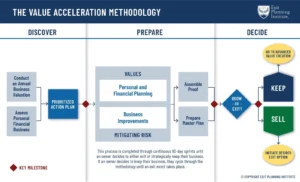
- Attractiveness and Readiness: Business owners must complete personal, financial, and business assessments to produce two scores: Business Attractiveness and Exit Readiness. Improving business value today prepares the business for success when the owner decides to exit.
- A business’s attractiveness is how attractive it is in the eyes of a buyer and is determined by the Attractiveness Index.
- Exit readiness is how ready the business and the owner is to transition and is determined by the Readiness Index.
Derisking the Business
- Reducing Owner Dependence: Businesses that are extremely owner-dependent often have negatively impacted intangible capitals. If most customers work directly with the owner, the buyer risks losing many clients when the owner leaves. Also, when an owner controls many of the business’ production activities, it creates risk and stunts the business’s growth.
- Documented Processes: The lack of documented processes and standard operating procedures (SOPs) will negatively impact business value. Documented processes allow for smoother transitions when employees leave and when new employees are onboarded.
- Customer Concentration: A diverse customer base means no single customer makes up a large percentage of the overall revenue.
How it Builds Value in Tampa
- By focusing on these intangible assets, Tampa business owners can create a more robust and valuable business.
- By addressing risks, such as owner dependence and customer concentration, a business can increase its attractiveness to potential buyers and strengthen the business.
- By strengthening human capital, a business can retain key employees, ensuring stability and continued success.
- By focusing on social capital, Tampa business owners can build positive company cultures that improve morale and productivity.
- By building strong customer relationships and creating an “entangled” customer base, a business can create recurring revenue and increase their value to the customer.
- By implementing robust structural capital, Tampa business owners can make sure their companies can operate efficiently and effectively without the owner present.
By addressing these areas, Tampa business owners can make their businesses more attractive to potential buyers, ensure the business’s continued success, and increase the overall value of the business. For more on business value creation contact Michael Shea of Transworld Business Advisors