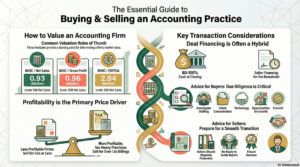
The Essential Guide to Buying & Selling an Accounting Practice
By Michael Shea, Transworld Business Advisors of Tampa
Accounting practices remain one of the most consistently active segments in the lower-middle market. Whether you’re a CPA considering retirement or a growth-oriented buyer looking to acquire recurring revenue, understanding how these firms are valued—and how deals are structured—is critical to achieving a successful transaction.
Below is a practical, experience-based guide to buying or selling an accounting practice, based on real transaction data and what actually drives value in today’s market.
How Accounting Firms Are Valued
While no two firms are identical, most accounting practices are valued using a few well-established rules of thumb. These metrics provide a starting point, not a final answer.
Common Valuation Benchmarks (Under $1M in Net Sales)
- MVIC / Net Sales: ~0.93× (median)
- MVIC / Gross Profit: ~0.96× (median)
- MVIC / EBITDA: ~2.94× (median)
These multiples reflect market behavior, but the final valuation depends heavily on profitability, client quality, and transferability of relationships.
Profitability Is the Primary Price Driver
Revenue alone does not determine value. Profitability does.
In practice, we see a clear split:
- Lower-profit firms often trade at 1.0× revenue or less
- Well-run, tax-heavy firms with strong margins often sell for over 1.1× billings
Buyers are ultimately purchasing cash flow and stability—not just top-line revenue.
Key drivers of higher multiples include:
- Consistent owner-adjusted EBITDA
- Recurring tax and monthly accounting work
- Clean financials with minimal add-backs
- Limited client concentration
Deal Structure: Financing Is Often a Hybrid
Unlike many other industries, accounting practice transactions frequently involve a blended financing structure.
Typical Structure
- 80–100% cash at closing
- Seller financing for the remainder
Seller notes help bridge valuation gaps, demonstrate seller confidence, and improve deal certainty. From a seller’s perspective, strong firms with clean operations often command more favorable terms and shorter note periods.
Advice for Buyers: Due Diligence Is Critical
Accounting firms can look very similar on the surface, but the details matter.
Buyers should pay close attention to:
- Staffing: Who actually services the clients?
- Client concentration: Are revenues dependent on a handful of relationships?
- Technology: Is the firm modern, cloud-based, and efficient?
- Growth opportunities: Can services be expanded or fees adjusted?
- Transition commitment: Will the seller stay involved long enough to ensure retention?
Proper diligence protects against revenue erosion post-closing and ensures a smoother transition.
Advice for Sellers: Prepare for a Smooth Transition
The most successful accounting practice sales don’t start at listing—they start 12 to 24 months earlier.
Sellers should:
- Organize and normalize financial statements
- Reduce owner dependency where possible
- Document workflows and client processes
- Be prepared to guide the buyer during transition
- Communicate stability and continuity to clients
Firms that are well-prepared not only sell faster—they sell for more.
Final Thoughts
Buying or selling an accounting practice is a nuanced process that blends valuation science with human relationships. With the right preparation, realistic expectations, and experienced guidance, both buyers and sellers can achieve excellent outcomes.
If you’re considering a transaction—confidentially and thoughtfully—I’m happy to help you evaluate your options and navigate the process.
Michael Shea
Business Broker | Transworld Business Advisors of Tampa
👉 Learn more at: www.yourfloridabusinessbroker.com
Michael Shea represents the Tampa Florida Transworld office. In business since 2005, he has established a reputation as a trusted business broker across Florida’s key markets- from Tampa to Orlando, Melbourne, and more. Over the past two decades, Michael and his team have closed over $1 Billion in sold business volume and presided over more than 450 transactions. His credentials include the IBBA Certified Business Intermediary®, and most recently, the prestigious Certified Exit Planning Advisor® (CEPA) credential.